
Resources
Welcome to the Resource Center. In this room we share our stories and reflections related to our own experiences of making places, as well as those of living in places that are worth remembering and passing on as good lessons for the future. We are now able to share course lectures with you as well.
You are most welcome to get in touch with staff if you have stories you would like to share.

The Long Path that Leads from the Making of Our World to God
My work has proven this to me: There is available to us, a form of transformation which, each time it is applied, extends and enhances the wholeness of the land, and the act of using this process of transforming puts us in touch with ourselves…

This essay was written by Christopher Alexander in 2007 to support his nomination for the Templeton Prize. Later, in 2016, a shortened version was published by First Things as “Making the Garden.” What follows is the original piece that describes the course of Alexander’s life and work, and his findings as he sees them.
“My work has proven this to me: There is available to us, a form of transformation which, each time it is applied, extends and enhances the wholeness of the land, and the act of using this process of transforming puts us in touch with ourselves. This means that it makes the land of the Earth become more and more deeply connected to our selves. An environment, when made in this way, may even be regarded as a vision of our inner selves.”
It has taken me almost fifty years to understand fully that there is a necessary connection between God and architecture, and that this connection is, in part, empirically verifiable. Further, I have now come to the view that the sacredness of the physical world – and the potential of the physical world for sacredness – is a powerful, surprising, and sure path to recognizing, and providing small steps towards understanding the existence of God, whatever God may be, as a necessary part of the reality of the universe.
Only in the last twenty years has my understanding of this certainty taken somewhat explicit form, and it continues to develop every day. It has led me to explicit visions of God, and to understanding of what kind of entity God may be, coupled with a way of talking about these things that allows them to be understood in straightforward terms.
I believe it may be understood by all of us – by ordinary people, by scientists, and by religious seers.
All this comes from the task of paying attention to the earth, its land and rocks and trees, its buildings, and the people and ants and birds and creatures all together, and its blades of grass. It comes from paying attention to the fact that the task of making and remaking the earth that we call architecture, is at the core of this common sense understanding.
-o0o-
Starting in about 1956, I began for the first time, consciously, to try and find out what architecture is. I had by then received my degree in mathematics, at Trinity College, Cambridge, and began, as I had always intended, to undertake a second degree, this time in architecture, also at Trinity College, Cambridge. As I began to take in what I was being taught at Cambridge, I felt that the then-prevailing idea of architecture was rootless and arbitrary, mainly governed by styles and pointless quirks of style, and that what was typically said about it by architects was peculiar, very often meaningless, and above all egocentric. In 1958, as early as I could after completing my architecture degree, I left to go to the United States, to do a PhD in architecture at Harvard. That was the moment when I first got my feet on the ground, and began trying to define the true nature of architecture from first principles.
To get my feet on the ground, and to have something solid that I could be sure of, I started by examining the smallest particles of functional effect, that I could discern in buildings, with small and sometimes barely significant aspects of the ways that buildings affect people. My purpose in doing this, was to focus on the smallest particles of fact that I could be certain of: something that was extraordinarily difficult when faced with the porridge of mush that then passed for architectural theory. In the early years my studies were based on the most ordinary, miniscule observations about usefulness and the effect of buildings on the people who lived in them, always keeping the observations modest, reliable -- small enough and solid enough so that I could be sure that they were true.
At first I included very small particulars of functional effect in any matter that actually made a practical difference to daily life… a shelf besides the door where one could put a packet down while searching for ones keys, for instance, or the possibility of a sunbeam coming into a room and falling on the floor.
But I quickly realized that some of these details were very much more significant than others. Those like the first (the shelf) tended to be pedestrian, even though useful; while those like the second (the sunbeam) were more uplifting, and clearly mattered more in some obvious but profound sense. I began to focus on those miniscule points which mattered more, in the sense of the second example. Gradually, then, I was able to pave the way to the possibility of seeing how buildings support human well-being – not so much mechanical or material well being, but rather the emotional well-being that makes a person feel deeply comfortable in himself. And as I studied these small effects carefully, I was led to a conception of wholeness, wellness, and spiritual support that might, under ideal circumstances, be present between buildings and human beings.
Starting with these very humble and detailed pictures of what seemed to “matter” in a building, for fifty years I have struggled to provide a basis for architecture, which is able to sustain human feeling, and the human spirit. I made an effort to penetrate the logic of architecture, and the logic of architectural value – in the hope that I could alter the devastating effect of what has become called “modern” architecture on human beings, on human society, and replace it with an idea and practice of architecture that could help people sustain the sanctity of life – both in their hearts and in society.
-o0o-
I suppose it is fair to say that there are two approaches to the reality of God: one is faith, the other is reason. Faith works easily, when it is present, but it is luck, or one’s early history in family life, or a blinding insight of some kind that determines whether one has faith. Reason is much harder. One cannot easily approach the reality of God, by means of reason. Yet in 20th century discourse reason is almost the only way we have of explaining a difficult thing so that another can participate.
It is reason, the language of science, and its appeal to sharable, empirical observation and reasoning that has given our modern era its strength. Yet, as just said, one is unlikely to encounter God on the basis of reason.
However, and again yet, there is a persuasive logic in the coherent and well constructed arguments from empirical observation and fact that may even reach to spiritual truths.
This story of my life, is one which began with childlike, primitive faith, which then took me through dark forests of non-understanding, and was finally able to emerge into the light of day, with a vision which is both visionary and empirical. It is a vision which has roots in primitive faith, and from it builds bridges of logic and scientific coherence towards a new kind of visionary faith rooted in scientific understanding. This new kind of faith and understanding is based on a new form of observation. It depends, for its success, on our faith (as human beings) that our feelings are legitimate. Indeed, my experiments have shown that in the form I have cast them, they are more legitimate and reliable, perhaps, than any other human sensations.
And it is in this way that I was led from architecture to the intellectual knowledge and love of God. It was my love of architecture and building, from which I slowly formed an edifice of thought, that provides for the existence of God as surely as we have previously known the world as made of space and matter.
-o0o-
I never taught or spoke about God consciously, as part of my work as an architect. As professor of architecture at the University of California, Berkeley, I tried to teach and write in ways that were consistent with my background in science and mathematics. It also seemed highly incongruous to bring God into my discussions of architecture, because I was simply trying to find out what was true, and write it down. A fairly straightforward process, I thought, following well-tested methods of scientific enquiry. So that is what I set out to do, and that is what I did. But in my heart, I was always aware that I did maintain an inner knowing that the best way to produce good architecture must somehow be linked to God, indeed that architecture was always about God, and that this was the source of any strength I had in being able to identify the real thing.
But in the early days these stirrings were very much private, interior to me, and subdued.
I was a practicing Roman Catholic, I learned much from Christian mystics (The Cloud of Unknowing), from Sufi saints (Mevlana, Ibn Arabi), from Buddhist and Taoist writers (Chuang Tzu and Lao Tse, especially the Tao Te Ching), from Zen poets especially Bashō, from south-sea anthropologists Gregory Bateson, Ruth Benedikt and Jane Resture, from the texts of the Sanskrit classical canon, from western writers such as the French psychiatrist Hubert Benoit, from Aldous Huxley, and from the age of enlightenment, especially from Spinoza.
During my years at Berkeley, I encountered considerable resistance from the faculty and administration. Even though the religious content of my work was not articulated, the university made continuous efforts to diminish the importance of my work, and did their best to dissuade students from taking my classes. This took place because the spiritual content and underlying message, though always presented in a form acceptable to common sense, struck them as an attack on the prevailing forms of thought and practice in fashionable 20th-century architecture.
Indeed, to protect myself and my students I was obliged during the period 1985 to 1992 to undertake a First Amendment law suit against the University, since the university was undermining my right to teach what I believed to be true. I was by then a full professor in the Department, but nevertheless it took seven long years, before I prevailed in my right to teach the approach I had formulated, and was able publicly to go ahead with research and further reasoning that made full sense to me.
During all these years I had still not yet formulated an explicit way of understanding the connection between God and architecture, nor had I yet found it necessary to do so. But half consciously, it was always at the heart of what I was doing. Questions about the nature of God, the relation between God and our concepts of modern physics, the apparent disparities between the various views of God presented in different cultures and religions, were with me every day, and for several years I undertook various forms of practice – Zen Buddhism, the writings of Mevlana, private forms of meditation -- to do what I could to sharpen and clear my mind.
As time went on, I also began formulating practical and modestly helpful theories, which enabled me (and others) to build better buildings. Some of my works became widely read, and translated into many languages.
These theories were focused on the search for a deeper sense of well being – not thermal comfort, or energy saving, or comfort of illumination on surfaces. The issues I found most helpful were connected with a deeper, psychological and emotional comfort, in which people could feel their own existence as human beings. These theories gradually became widely accepted, but also continued to raise discomfort in the profession, because they plainly were at odds with the stark and ego-centered view of buildings which was then being taught by most teachers of architecture, and which was commonly accepted in late 20th century society as the “correct” view.
But as a result of struggling to understand these things at the deepest level, and while establishing a foundation which seemed ordinary, and practical, and dependent on common sense, I found it more and more difficult to fit together a well-defined scientific or intellectual model of what was going on, in a way that could encompass these simple matters. And yet it was also clear to me that the empirical reality of these simple observations could not be denied, and certainly could not be abandoned.
Indeed, in the period from 1979 to 1990, I found to my great surprise, that I was gradually forced to wrestle with questions about the nature of reality, the nature of space, the nature of value, the nature of human freedom. As I moved forward, the urgent necessity to clarify these issues became more and more important. Coupled with these problems, I also found that within the positivistic, scientific canon I had grown up with as a student at Cambridge, it was virtually impossible even to formulate adequate concepts that would be capable of solving the more profound issues which lie at the root of architecture.
I resisted this internal mental pressure from the scientific philosophy and practice of my youth, for as long as I could. I had been trained in physics and mathematics, and assumed, virtually as part of my educational birthright, that these disciplines could be relied on, and that I should not step outside the intellectual framework which they provided and allowed. But to solve the practical and conceptual problems I had to address, I now embarked on study of a series of concepts, which, though formulated more or less within scientific norms, nevertheless opened doors, and ways of thinking, which were highly challenging to the academic establishment.
1. Wholeness
2. Value as an objective concept
3. Unfolding wholeness
4. Connection with the inner self
5. Centers
6. Structure-preserving transformations
7. Degree of life
These concepts, and a few others, were introduced, by me, because I found them to be essential to the task of thinking clearly about the life of buildings. Yet they were almost not definable within the terms of reference of then-contemporary scientific thinking. This was true to such a degree, that even raising these topics as matters for discussion and clear thinking in professional architectural circles, caused raised eyebrows, obstructive discussion, and certainly little sincere effort to get to the bottom of the issues needing discussion.
One by one, then, I allowed these concepts into my everyday way of thinking, doing my best to hold to the scientific rigor and clarity as far as I could, yet trying to form models which would adequately portray the needed concepts in a way which could make sense of them.
During 1978-85, while I continued working on Volumes 1 and 2 of The Nature of Order, I went as far as I was able, to lay the ground work of a new model.
One might say that this new model relied heavily on new forms of experiment, in which a person would attempt to judge the quality of an action, or a building, or a painting, by consulting his own self, as to the degree of wholeness, or healed-ness, that appeared in the items under discussion or investigation.
-o0o-
This was the beginning of a very new way of thinking about architecture, which viewed the environment and its structure, as an instrument interacting with human beings in such a way that people could heal themselves. In short, it was the beginning of a practical theory of healing environments – still far from the subject of God -- but beginning to point in that direction.
This theory was put forward in a number of books by my coworkers and myself, of which the most important was probably A Pattern Language, which has (I am told) become the best-selling architecture book of all time. Other companion volumes included A New Theory of Urban Design; The Production of Houses; The Linz Café; The Oregon Experiment, all published between 1975 and 1983. The concepts embedded in these five books, created the beginning of a generative theory with which people could produce well-functioning environments for themselves. As a group these books have become a standard work in architectural education, all over the world.
As the use of these concepts proliferated, and as my colleagues and I continued experiments in which we did our best to apply these principles to real building projects, it became more and more clear that we needed to sharpen our idea of health, and clarify the target of this work.
It was urgent to be able to provide a more solid conceptual and experimental foundation, which could provide us with operational definitions of health, and which would also provide us with practical ways of understanding health, and with practical ways of helping us to judge which environments, and which kinds of environments, were indeed most successful in sustaining or promoting health.
This task began to lead, for the first time, to my finding an empirical hint of the presence of God. In effect we began to discover a new kind of empirical complex in buildings and works of art that is connected with the human self, God, spirituality, social and mental health, and ways of understanding the role that love plays in establishing wholeness, the role of art, and conscious awareness of the human being as part of some greater spiritual entity.
These arguments are conveyed in The Nature of Order, Books 1 and 2.
-o0o-
I would like to summarize the content of this new kind of empirical complex in the following way. In any part of what we call nature, or any part of a building, we see, at many levels of scale, coherent entities or centers, nested in each other, and overlapping each other. These coherent entities all have, in varying degree, some quality of “life.”
For any given center, this quality of life comes about as a result of cooperation between the other living centers at several scales, which surround it, which contain it, and which appear within it. The degree of life any one center has, depends directly on the degree of life that is in its associated centers at these different scales. In short, I had identified a kind of wholeness: in which the life of any given entity depended on the extent to which that entity had unfolded from the wholeness.
When one contemplates this phenomenon soberly, it is hard to imagine how it comes about. But what is happening is, in effect, that life appears, twinkling, in each entity, and the cooperation of these twinkling entities creates further life. You may view this phenomenon as ordinary. Or you may think of it, as the Buddhists of the Hua Yen canon did, when they viewed it as the constantly changing God-like tapestry that is God, and from which life comes.
In this view, architecture contributes to the world, to just that extent to which it plays its role in this tapestry: and that in turn comes about as a result of the extent to which a building, or an outdoor place between buildings, or a doorway, is composed entirely of entities which are themselves whole and entire, and which – each one of them – make us feel whole and entire. This is in any case, an attempt to make a picture of the Whole.
-o0o-
You see then, how it is that the careful study of architecture, led me – and I believe inevitably leads – to thoughts about the nature of things, and the simultaneous existence of what we may call the objective (outer) nature of things – typically dealt with in science – and at the same time the existence of what we may call the subjective (or inner) nature of things. The discovery, which is new, is the discovery that the so-called subjective, or inner view of things, is no less objective than the objective- outer-mechanical view of things. When questions about the subjective are asked carefully, and in the right way, they are as reliable as the experiments of physics. Indeed, this understanding has led to a new view of experiment, which uses the human being as a measuring instrument, and leads to reliable, shared results when properly done.
This has come to light because of my interest in architecture. In conventional philosophy, there is nothing which allows one to test the reality of God, or of visions inspired by God. But when a person is asked to compare two buildings, or two doorways, and to decide which one is closer to God, this question will be answered in the same way by different people, and with a remarkably high reliability.
All this, the experiments, the vision, and the consequential impact on planning and architecture, seem to have a unique ability to point to the reality of God. In theory, other disciplines like ethics, might seem to have more claim to lead to a knowledge of God. But the tangible substance of architecture, and the fact that in a successful architecture every tiny piece is (by definition) suffused with God, either more or less: this gives the concept of God a meaning, essentially translated from the beauty of what may be seen in such a place, which shows us God made manifest in a way that has rarely before been claimed, or seen, or attempted.
It is this, I believe, that ultimately thereafter then leads us to see God, and to know God. If we pay attention to the beauty of those places which have the quality that self-like, or God like entities are visible there, and we see the extraordinary tangible beauty that such places have, it enables us to see God in a down-to-earth way. The thought of God, the meditation on nothing, which makes room in our hearts, and, as a consequence, that which is truly good can flow from it. That follows from the awareness in our hearts, and from our active effort to make things that make the Earth beautiful.
This is not a pastiche of pseudo-religious phrasing. In technical language, it is the structure-preserving or wholeness-extending transformations (described in The Nature of Order and capable of being precisely defined) which show us how to modify a given place in such a way as to give it more life, and when applied repeatedly, this kind of transformation is what brings life to the Earth, in any place.
Earth -- the physical Earth and its details – sand, water, rocks, birds, animals and trees –this is the garden in which we live. We must choose that we are gardeners; we must choose to make it our task to make this garden beautiful. Understanding this properly will give us both intellectual insight into the nature of God, and also give us faith that we may believe in the existence of God, as something immense, yet also as something modest, something which lies under the surface of all matter, and which comes to life, and shines forth, when we treat the garden properly.
The most urgent, and I think most inspiring way we can think about our buildings, and our way of making and remaking the Earth, is to recognize that each small action we take, in placing a step, or planting a flower, or shaping a front door of a building, is a form of worship – an action in which we give ourselves up, and lay what we have in our hearts, at the door of that fiery furnace within all things, which we may call God.
The kind of architecture these practices lead to is comprehensively demonstrated in The Nature of Order, and particularly in Book 3, A Vision of a Living World.
The condition which makes this (seeing God in the world around us) true, occurs only if the quality of the architecture is right – an almost unattainable condition in today’s world. Why is it almost impossible? Because in an epoch when God was not acknowledged, it became virtually impossible for people to build the kinds of buildings where God appears. The whole purpose of the work I have done, is to show (a) that the presence of God in a matter-configuration is an objectively existing condition, and (b) how we may create buildings where the presence of God can be seen and felt.
The two go hand in hand.
We cannot make an architecture of life, if it is not made to reflect God – an objective condition. And, by a surprising twist, the search for a true architecture, that is to say, a real architecture which works, and in which this feeling of rightness is present in every bone, in an irreligious era has the unique power to bring back the reality of God to center stage in our concerns.
-o0o-
My work has proven this to me: There is available to us, a form of transformation which, each time it is applied, extends and enhances the wholeness of the land, and the act of using this process of transforming puts us in touch with ourselves. This means that it makes the land of the Earth become more and more deeply connected to our selves. An environment, when made in this way, may even be regarded as a vision of our inner selves.
The best state for the land – our best actions on the land, in the land and in the buildings – will come from our awareness of its wholeness and from our awareness of its connection with our own selves – that is to say, with God, that substrate of the universe which is the origin of who and what we are.
As I have said, our ability to grasp the wholeness, our ability to see it, and to adhere to it – these are all profound, and often difficult. But in order to understand these operations from a practical and mathematical point of view, we need to be guided by an inner voice – and I believe that voice is, essentially, tantamount to a vision of God. Thus, although it is formless and shapeless, nevertheless it is this vision of God which draws us on.
That new vision can become a new source of inspiration and motivation. I call it new, not because it is at root genuinely new. Of course it is not, it is ancient. But it is entirely new in our era, to take such a thing with full seriousness, and to be able to derive from it, well-fashioned, scientifically endowed conceptions of what is needed to heal a given place. It will not be governed by money, or profit; it will not be governed by social politics; it will be governed simply by the desire and firm intention to make beauty around us, and to contemplate the true nature of beauty, which is humility.
Perhaps that sounds as though it is not solid enough for sober and enlightened action. I have come to believe that quite the opposite is true. The vision of God we hold in our inner eye, that we draw from the hills and mountains, from the cities towers and bridges, from the great oak trees, and from the small and tender arbors, and from the stones and tiles and colors which have been carefully laid by people forming bricks, and building with them, it is that which is God, and which we encounter as we try to find a vision of God in the world. This will then guide us surely, as if with a certain hand, towards those things that can emerge from the present wholeness, and lead towards a future which is yet more beautiful.
The capacity to do this lies in the heart of every man and every woman… it is stark in its simplicity. To make each brick, each path, each baluster, each window sill, a reflection of God. The world shaped by this presence, will thrive from it, and will surely lead us back to a vision of God, and a sense of right and wrong, and a sense of well-being. This vision of the world – a real, solid physical world, that is built with this in mind – will lead us back to a vision of God. Future generations will be grateful to us if we do this properly.
So indeed, I have concluded that the work of taking architecture seriously, as I have tried to do, will slowly , but inevitably, lead us to the proper treatment of tiny details, to an understanding of the unfolding whole, and to an understanding – mystical in part – of the entity which underpins that wholeness.
Thus, as I promised, the path of architecture does seem to lead inexorably towards a renewed understanding of God. It is an understanding very far beyond religion, something which is true within the canon of every religion, not connected with any one religion in particular, something which therefore moves us beyond the secularism and strife that has torn the world for more than a thousand years.

Making the Garden
It has taken me almost fifty years to understand fully that there is a necessary connection between God and architecture, and that this connection is, in part, empirically verifiable…
This article first appeared in First Things, in February 2016. It describes Alexander’s career-long search for the meaning of architecture.

Creative Process
Knowing that our devastated civilization cannot be repaired in a hurry, we may assume it can be rebuilt and reaffirmed only if we go very deep into the foundations of this new potential civilization. That requires, as underpinning, a renewed physical world, together with a new way of building and looking after land…

This picture is of the Eishin construction site -- the Great Hall and the Main Gate. It demonstrates using stakes, poles, and ropes, to mark the position of the entrance street, all the time judging the shape and position of the space of the entrance street as it was developing. The creation process [described in this book] presents us with a disarming and powerful potential. Using the comprehensive paradigm of conceptual tools and stepwise actions, and taking the great care that has been described, it is within our power to recover the deeper aspects of human nature and work our way toward a compassionate and ethical civilization. It is possible to recover ourselves, our world, and a future for our children and their children – one that is rooted in profound and lasting values.
Knowing that our devastated civilization cannot be repaired in a hurry, we may assume it can be rebuilt and reaffirmed only if we go very deep into the foundations of this new potential civilization. That requires, as underpinning, a renewed physical world, together with a new way of building and looking after land.
We can begin now. We can lay out a new way of thinking which is, perhaps, deep enough to give us the stepping stones we need to replace the disastrous errors we made during the last century.
If we have sufficient courage, we can make a difference in our lifetimes. In a couple of hundred years we may have recovered ourselves, our wits, our common sense, together with a newly inspired framework, giving us back real architecture as the locus of our new life and our recovery.
The Battle for the Life and Beauty of the Earth: A Struggle Between Two World-Systems, Christopher Alexander, HansJoachim Neis, Maggie Moore Alexander, 2012, Oxford University Press, p. 475.
Battle for the Life and Beauty of the Earth, Alexander, Neis & Alexander (2012) page 194.
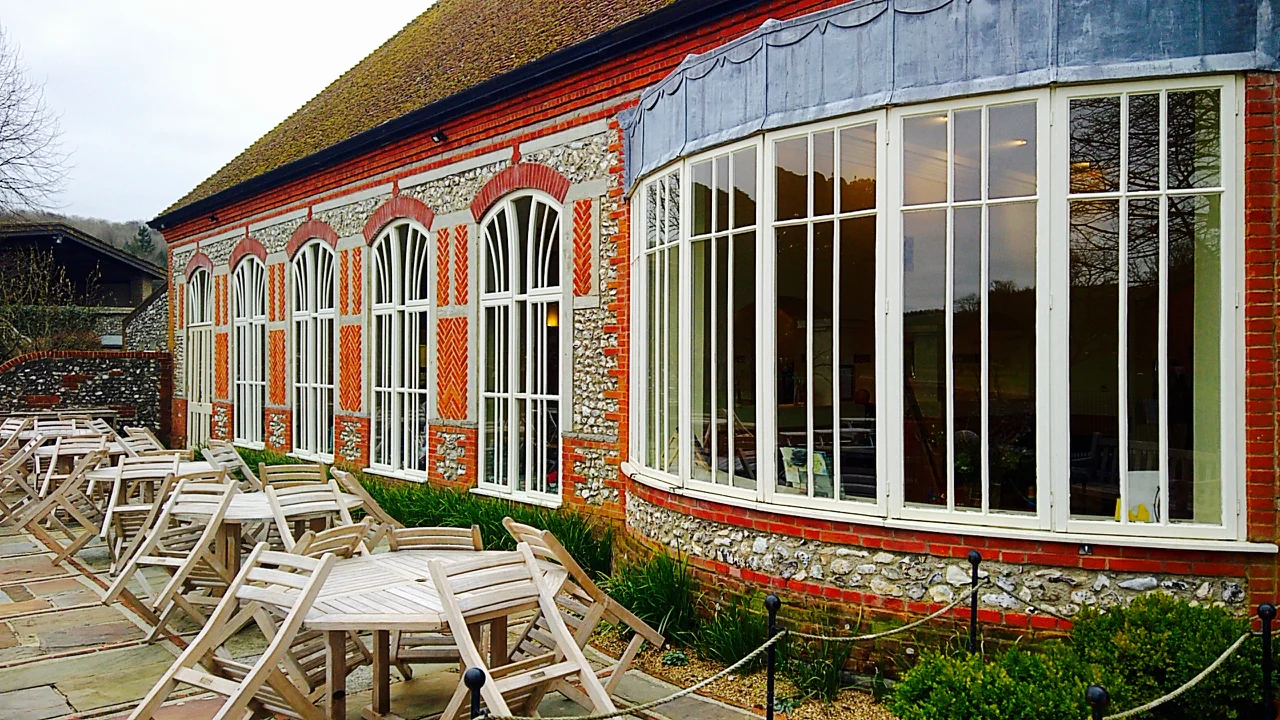
Interwoven Meanings of the Word “Feeling” In a Living Process
[T]here is always a structure latent in any given wholeness. This latent structure is the weakly held system of centers that are not quite defined yet, only partly articulated as a structure – yet which carry the inspiration of what this thing might be, where it might go. Every wholeness carries within it this “vector” in time, pointing in some direction, and indicating where it might go…

Since the word “feeling” has several different interwoven meanings in relation to a living process, I shall recapitulate the different ways that feeling and living process are connected.
1. I am talking about feeling as a way of grasping the wholeness of a situation. We grasp wholeness by feeling it, we obtain a nearly visceral feeling of the whole which puts us in touch with the whole.
2. I am also talking about a feeling of what to do next – at any given instant in the unfolding of the whole. The feeling, too, is generated in us as a feeling. We confront the whole, look at it, in the state it has reached, and we can feel where it wants to go or where it should go as its unfolding continues.
3. I am also talking about the importance of the idea that a building or any made object, when it has life, creates – generates – deep feeling in the person who encounters it. This principle that a thing, given life, has the obligation and function in the world to induce deep feeling in people – that is a third ingredient of my discussion.
4. Fourth is the fact that while making something, and when it is begun, or not yet finished, sometimes before it has begun, we carry the feeling in the form of a dimly held vision of emotional substance. We begin with a dim awareness, and we carry that dim awareness with us, as we move forward through concrete acts of structure-preserving unfolding to generate a new and vigorous whole.
5. Fifth is the fact that this feeling or vision of emotional substance comes into our minds from the whole which exists. It is the existing whole that inspires the feeling or vision of what it might become as it unfolds. This is why feeling helps us to perform structure-preserving transformations. By following the feeling, we are able to come close to the process of structure-preserving unfolding that must characterize the living process.
6. We have the fact that as artists, or as citizens, we need to be aware that any made thing – building, room, street, or ornament – has the obligation to create experience of deep feeling in us. We may think of this by saying that the thing itself has feeling when it lives.
7. Finally, there is always a structure latent in any given wholeness. This latent structure is the weakly held system of centers that are not quite defined yet, only partly articulated as a structure – yet which carry the inspiration of what this thing might be, where it might go. Every wholeness carries within it this “vector” in time, pointing in some direction, and indicating where it might go. This is the most important aspect of wholeness, and the reason we must try to “feel” the structure when attempting structure-preserving transformations, hence every step of a living process. That, too, is experienced by us as feeling.
Christopher Alexander, excerpt from The Nature of Order Book 2: The Process of Creating Life, page 373
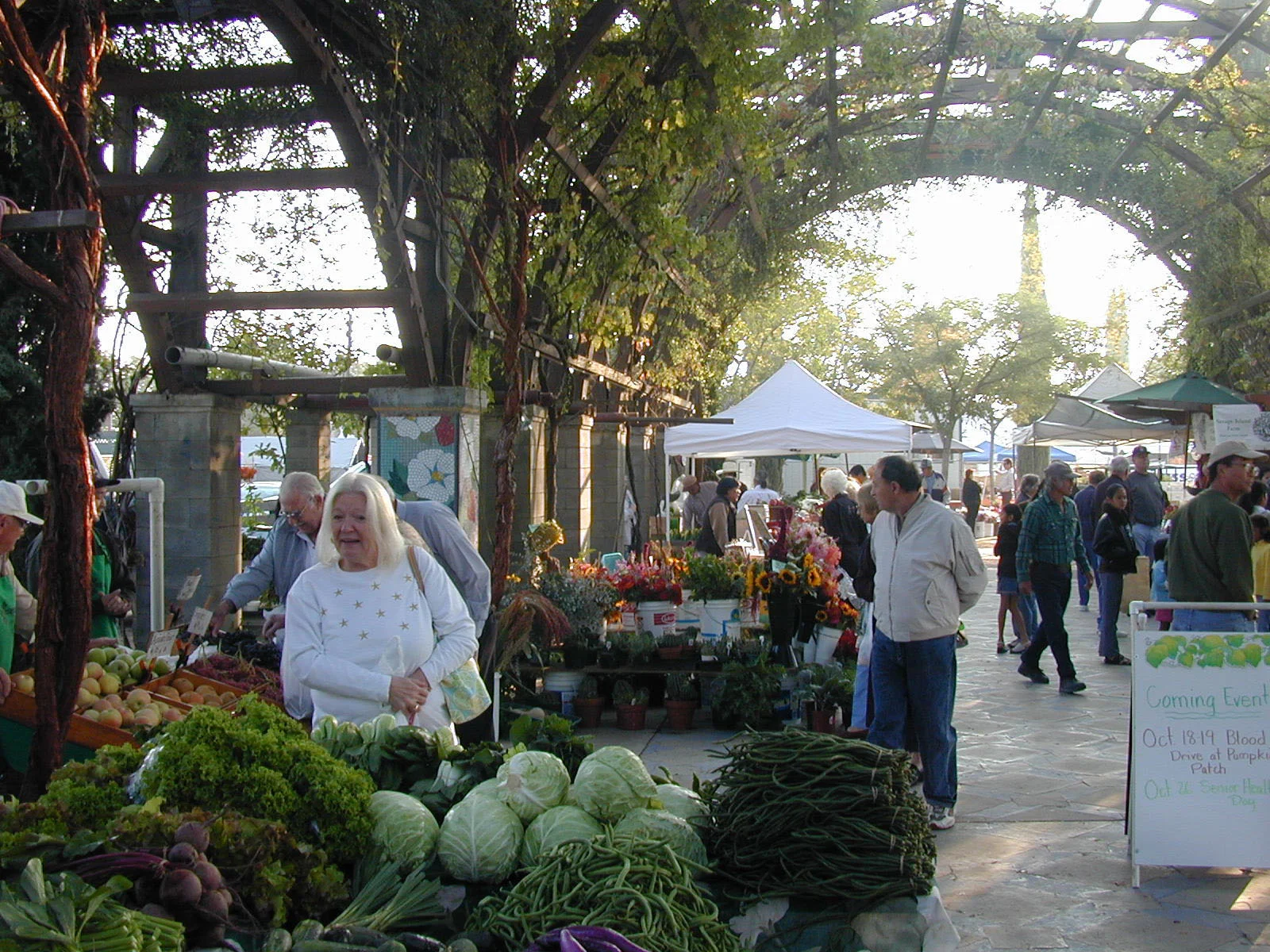
The Sense of "Belonging"
I believe process, deeply changed process, is the only real way for us to recapture our sense of belonging to the earth…

I believe process, deeply changed process, is the only real way for us to recapture our sense of belonging to the earth. In the course of the last thirty years of designing and building, and recording my failures and successes, it has seemed to me, more and more, that what governs the life in buildings – in any part of the environment – is something, some character, which can hardly at all be put there by the present-day processes which most of us in society today consider normal.
For our gardens, streets, houses, places of work, the shops where we buy, the places where we work, the cities where we meet – we may describe the best situations in all these places, when they are working well, as the situation where we – any of us, you, I, the next person – experience emotional possession of the world, where we experience “belonging.”
This belonging is a state in which the fine adaptation between people and their buildings and gardens and streets is so subtle, and goes so deeply to the ordinary core of human experience, that the people who then live and work and play in the garden or that street feel as if they are supposed to be there, as if it belongs to them, as if they are part of it, as if, like an old shoe, it is completely and fully theirs.
Of course, since we are social creatures this belonging is almost never individual or idiosyncratic. It is a state in which the world, as we create it, has this quality of seeming to belong to us collectively, It belongs to our own self, the self in which we are united with the world. It is a state in which we recognize, with joy, each gate, and field, and road, and tree; each window, and roof and nook and cranny, as a friend.
Historically, this quality has come about as a result of a long process – often lasting, sometimes even centuries. They are processes in which minute adaptations, carried out gradually, created this mutual sense of belonging, between people and their buildings.
In our present world, the opportunity for this very long time span, though it was needed in history to create such a sense of belonging, is simply not available. We live in a time where things move very quickly; where society evolves at very great speed; where people are highly mobile; where everything can change, daily faster than an eyeblink. Whatever process is needed to create this sense of belonging in our time must therefore be something entirely new. The historical forms of process, which created belongingness in historical society, will not do for us, and we must work to invent new kinds of process which may do it, again, in a new form and by entirely different means.
The problem is aggravated for architecture, too, by the fact that those social processes which now exist, our familiar processes of design, building, bidding, construction, financing, have all reached a state where they work together to produce an environment in which this lost state of belonging quite conspicuously does not occur.
It is this problem, above all, which is responsible for the callous, mercenary, and indifferent environment which we experience around us most of the time.
And it is this problem, which, slowly, my colleagues and I hope that we can begin to solve, together with all of you, during the next years, by offering entirely new kinds of processes that can begin to help us repair the living thing.
Christopher Alexander patternlanguage.com website, 2001
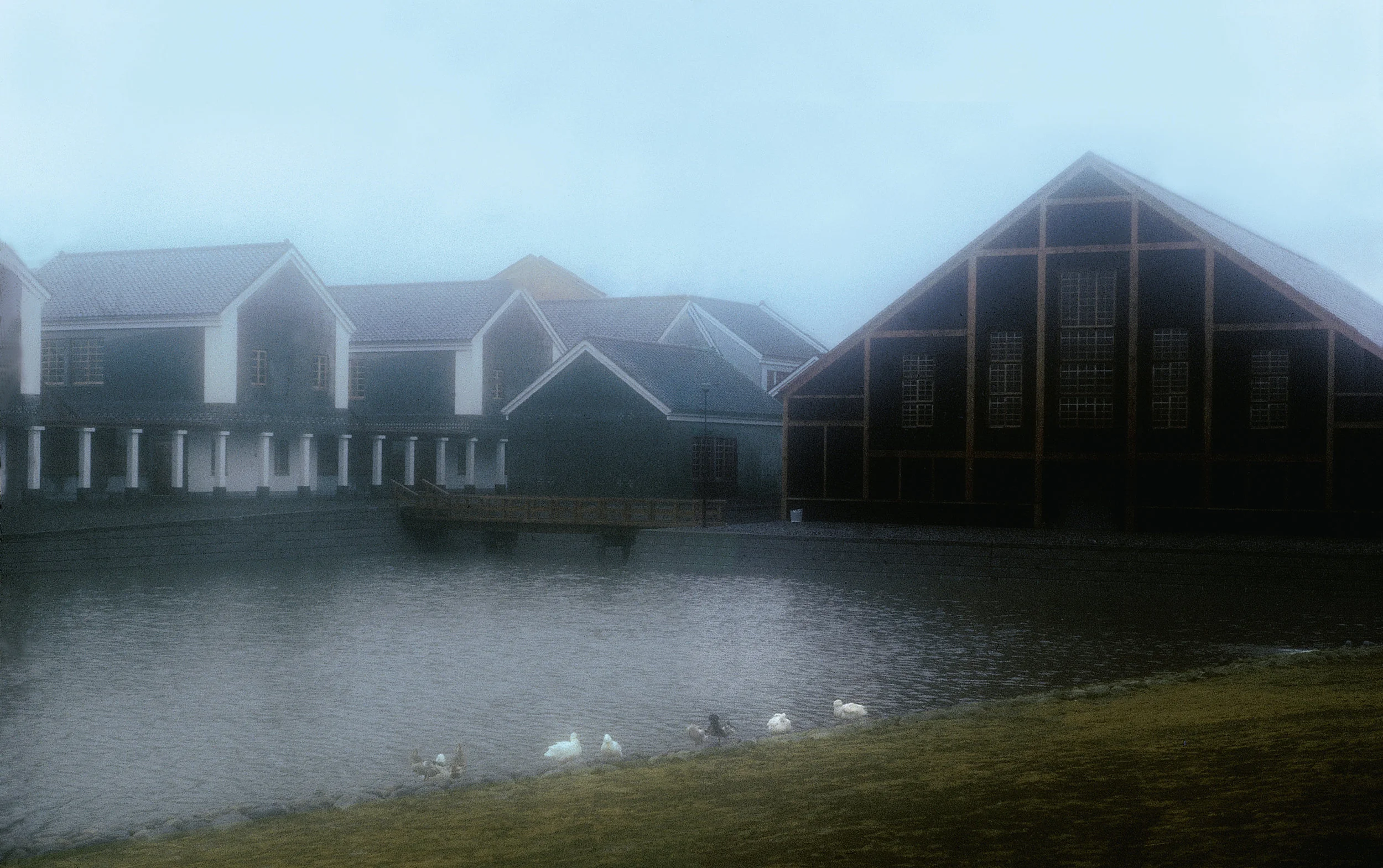
The Geometry of Living Reality and Beauty
What, then, is this whole that has arisen from the buildings we have built, working together with the students and teachers and visitors who come there, working with craftspeople, walking in silent pleasure, and taking in the atmosphere? It enlarges them all…

What, then, is this whole that has arisen from the buildings we have built, working together with the students and teachers and visitors who come there, working with craftspeople, walking in silent pleasure, and taking in the atmosphere? It enlarges them all. And why does it enlarge them? Why does it deepen their experience? It happens because the structure of the place forms strands, connections, interlocking elements, human connections too, and the matter which also comes through the soul, from the mind, and from the poetic substance which exists there.
When a state of wholeness is reached, we almost inevitably embrace the structure of the actual place. And it embraces us. The elements, centers, and properties are part of that embrace. The wholeness consists of a multistranded chain of interlocking properties and interlocking elements, forming one whole, and being nourished by that one whole. The place has something positive to give, and it nourishes people to be there. And the place has the power to help create life within the people themselves, and their interactions with one another.
Christopher Alexander
1. Photo: Eishin School, Japan. Words: from pages 412-413 of Battle for the Life and Beauty of The Earth: A struggle between two world-systems, Alexander, C., Neis, H., & Alexander, M. M. (2012). New York: Oxford University Press.
The Bavra Story
In 1961, at the age of 24, I lived in a village in Gujarat, India, for seven months. While I was living there, I felt I must be useful and after discussing with the villagers, we decided that a school would help them most…
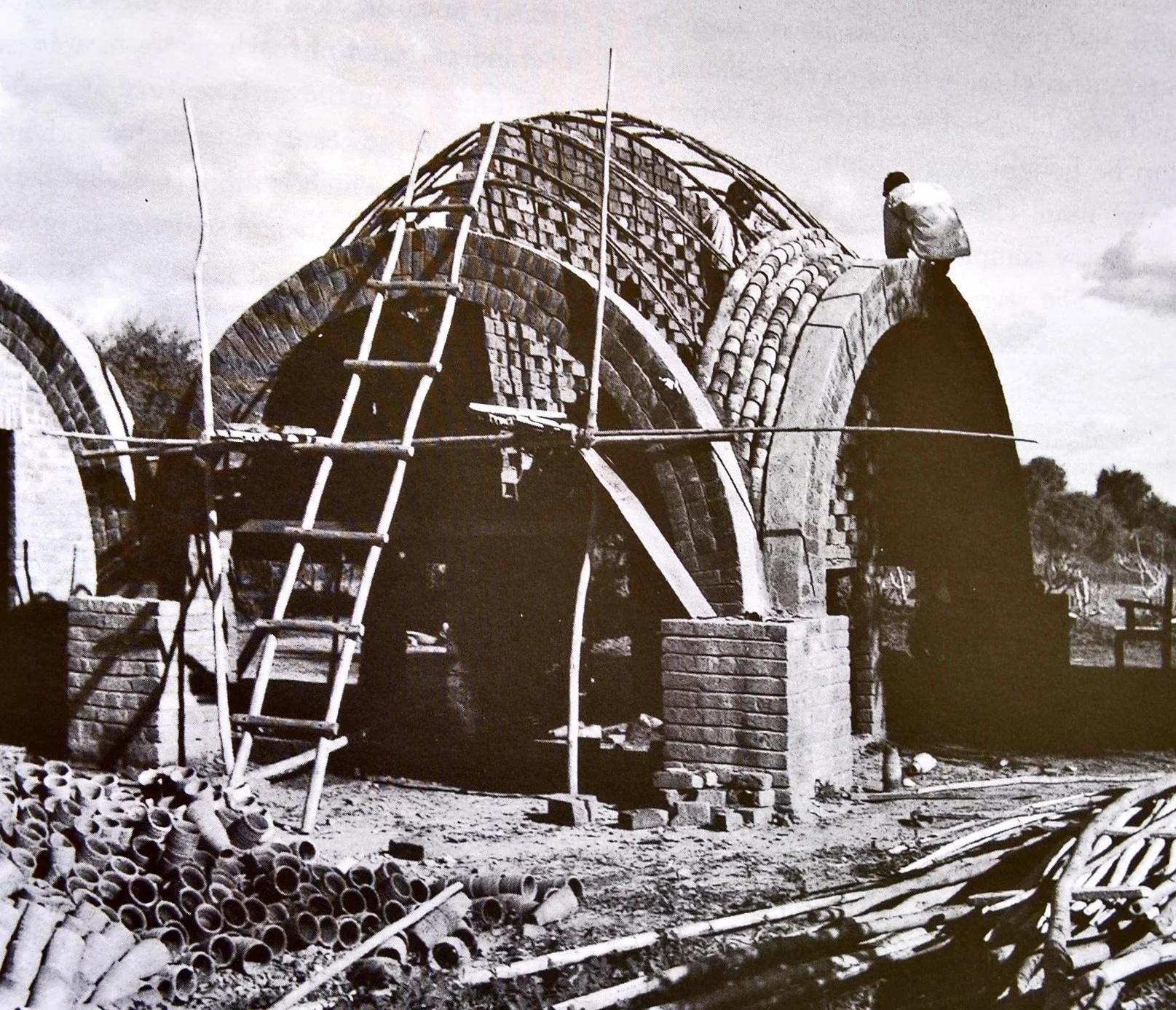
Alexander’s first building demonstrated his quest for simple beauty in the village of Bavra, in India, where he lived after completing his Ph.D. in Architecture at Harvard. Excerpt from The Nature of Order: A Vision of a Living World, Book 3, pages 526-7.
In 1961, at the age of 24, I lived in a village in Gujarat, India, for seven months. While I was living there, I felt I must be useful and after discussing with the villagers, we decided that a school would help them most. The four-room building is very basic. I did nothing except to try and make something useful that had a feeling like the village. This was my start in architecture. It was the first building I ever made and the first time I invented anything in construction. I had 5000 rupees (less than 1000 dollars) to build the school. Couldn’t import materials. No wood to speak of available. The village was five miles from the nearest road. What to do?
I asked the village potter what he could do. He showed me something he was used to making in the course of making roof tiles, a thing called a “guna” tile – a hollow truncated cylindrical tile with one end smaller than the other, about 16 inches long with a six-inch diameter at the base and a four-inch diameter at the top. In the normal course of events, it was split in two, down the middle, to form two roof tiles.
This fit perfectly into the situation. Mud and clay were abundant. There was virtually no wood available but small sticks and twigs sufficient for firing a rudimentary kiln were available in the scrubland around the village. I asked Shankarial, the potter, to make 3000 of these conical tiles for me just using mud from the village and then baking them but leaving them as cones, not splitting them down the middle.
Then I made the domes for the village school like this. Each dome had four brick arches on its four sides. Now imagine riffling these stacked tiles like a deck of cards, to get a curve. That is how we made the near-spherical vault. We laid one row of these next to the brick arch. Then the next one on the front row of tiles, and the next row on those. Because of the other brick arch, the riffled tiles rose higher and higher as they followed the curve. In those places where there was too much pressure, we filled them with earth so they didn’t crack under their own weight.
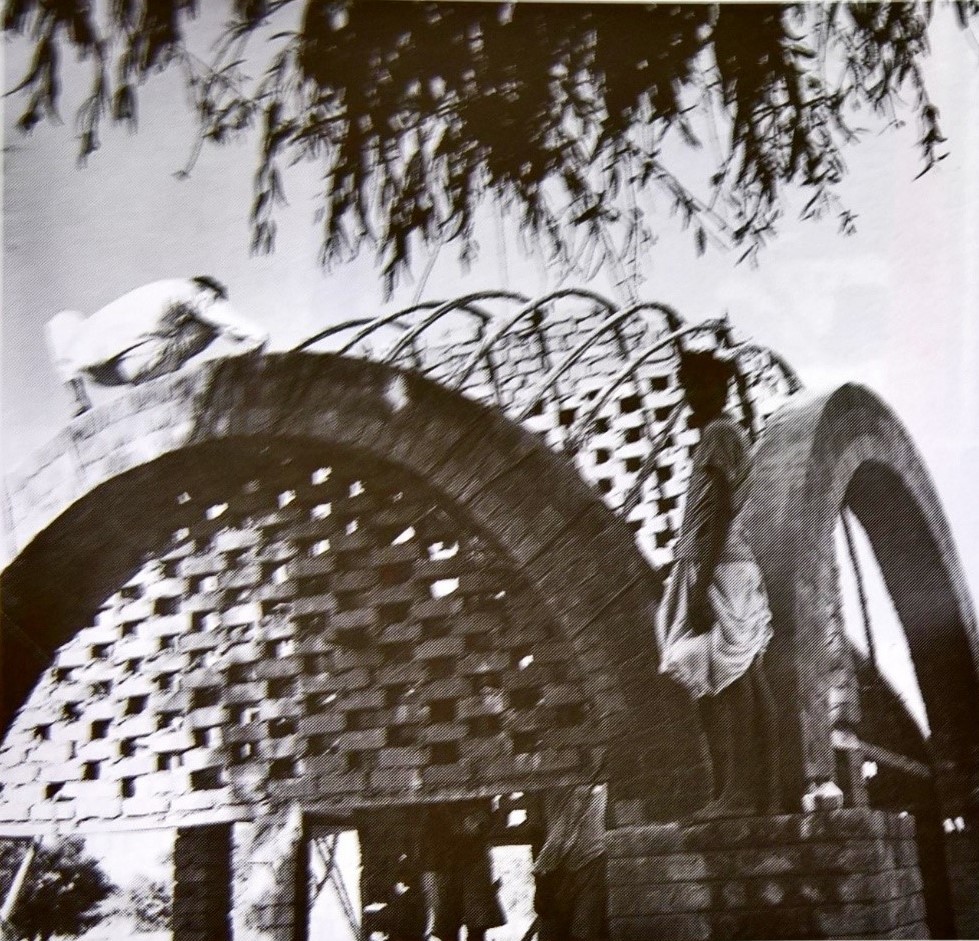
The formwork
Finally we plastered the whole thing. And, to make a tension tie that would resist outward thrust in the dome, I used cotton-bailing strap – a thin tensile steel strap used for tying up cotton bales and something we could get for nothing in the cotton-producing fields. Then plaster over the cotton-bailing strap. That was all.
Even then, at the very beginning of my life as an architect, I knew instinctively that to build a building, one has to invent ways of making. And, throughout my life I have always tried to invent ways of building which could easily, cheaply, make life and living centers in building forms. This was one of the first things I ever invented.
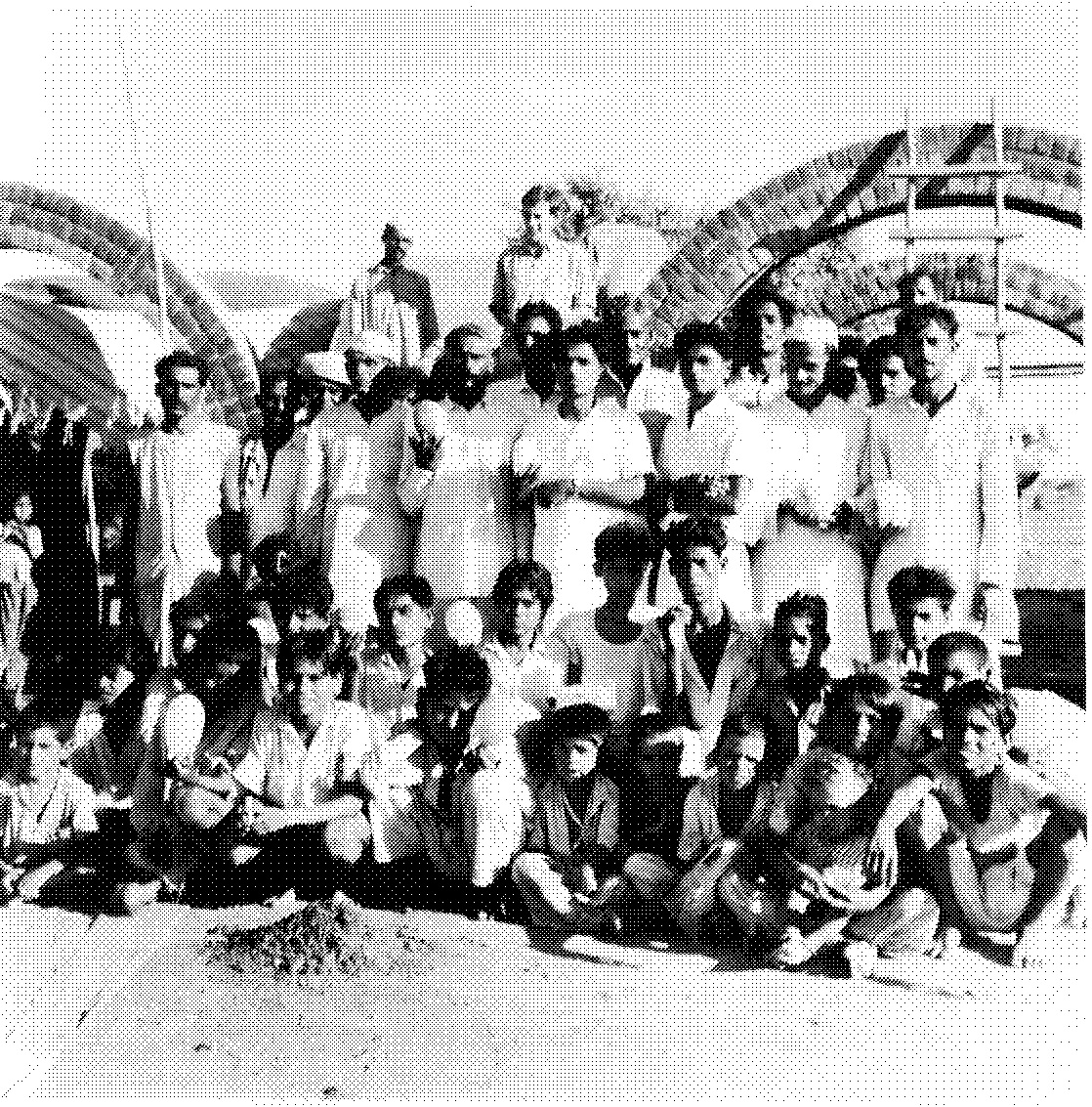
The Bavra Community
At least forty or fifty people from the village helped to build this building.
Christopher Alexander
More information about this project can be found in the Christopher Alexander & Center for Environmental Structure Archive.
You can download a report we have in the Archive here: https://christopher-alexander-ces-archive.org/report/village-school-in-bavra-elementary-school-bavra-india/.
There is also a much longer (82 pages) master plan downloadable here: https://christopher-alexander-ces-archive.org/report/master-plan-for-village-of-bavra-village-for-gujarat-india/.

Beauty...
Real beauty comes from layered and overlapping wholes and living centers. Above all, it comes from the multiplication of these living centers…
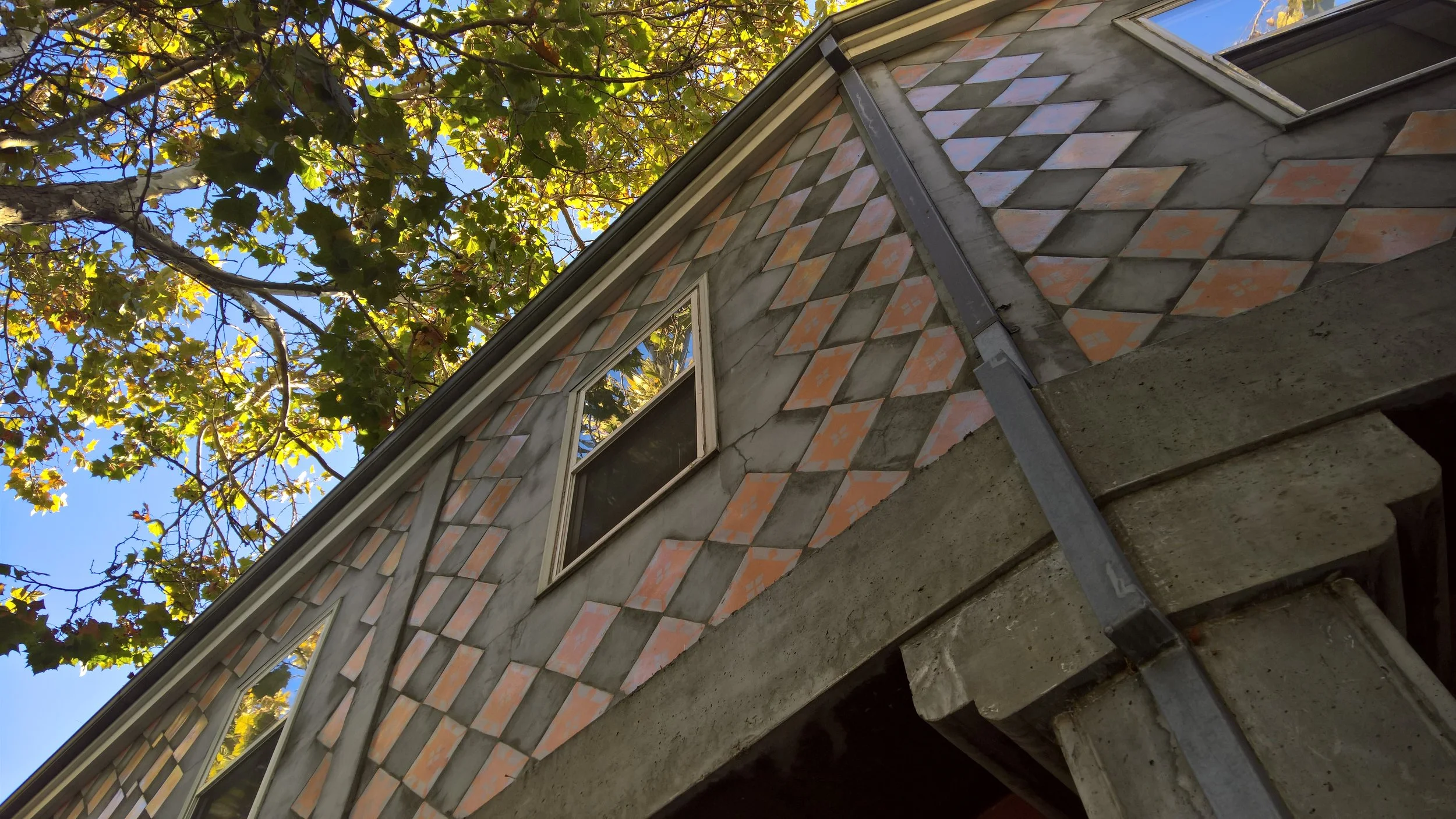
THE JULIAN STREET INN, SHELTER FOR THE HOMELESS, SAN JOSE, CALIFORNIA, (with Gary Black, Eleni Coromvli), Concrete columns, open lacework trusses, hand made column capitals, hand painted tile exterior, tiles fountain with lions head, dormitories with individual sleeping alcoves, tile roofs, gardens and courtyards.
by Christopher Alexander (1990)
Beauty is a light-hearted, easy thing, that sits on cobwebs, a cushion on a chair, a single camellia blossom hanging in the mouth of a jam jar. A man sitting relaxed, hands on his knees. A fence running across a hilly terrain, moving and waving with the up slopes and down slopes. Beauty is this quality, multiplied, simplified, at rest. Beauty is rare, precious.
Real beauty comes from layered and overlapping wholes and living centers. Above all, it comes from the multiplication of these living centers. It is soft, gentle, something that quietly celebrates life, without showing off, supports being more than doing, gives more often than it takes. It is marked by gracefulness of essence, not by gracefulness of its exterior. The multiplication which occurs in beauty, is a multiplication of possibility. It is not a shell which keeps you distant, but something which pulls you in, and makes you free -- encourages and allows you to be yourself, and to be free.
That multiplication, when it occurs, supports other forms of life, supports our lives, and appears, physically, in its gentleness.
We can repair the beauty structure on our Earth, only if we understand it.
The beauty structure is inherent in geometry. But once again, the "geometry" is not what it seems. When people speak about geometry, today, they are referring, most of the time, to very simple structures: rectangles, circles, straight lines, simple curves. These elementary forms, learned by every school boy and girl in elementary mathematics classes. Most of the buildings, roads, and neighborhood layouts of the 20th century era, were based on this sort of geometry.
Beauty structure is not likely to appear in a world of these kinds of forms. The geometry of nature, the geometry of complex adaptive systems, and the geometry which must inevitably be present, in any part of living Earth, is an adaptive structure of wholes and centers, being gently fitted to one another.
Even fractal geometry, sometimes put forward as an antidote to rigid geometry, is not the geometry of living structure. It does slightly resemble living structure, because of the multiplicity of scales that are inherent in it. But a fractal design, is made by following a rule endlessly. Living structure comes about by a process which is adapting constantly; each part is different, not because of the rule that forms it, but because the surroundings of each act, each whole, each center, is different every time. The living structure plays with this variation, and, by adapting to it, makes something perfect, even while in another sense, it is imperfect, and filled with imperfections.
Christopher Alexander, 2008, unpublished
Our Birthright
[W]hen I talk to politicians, to townspeople, to developers, when I watch the reaction in the newspapers, when I observe the studied (and to me frightening) neutrality of the journalist preparing to write his story, the most frightening thing of all is the loss that people have of their own feeling…
Christopher Alexander ends A Vision of a Living World, Book 3 of The Nature of Order series (pp.681-3) with this passage.
BACK OF THE MOON COMMUNITY, Austin, Texas.
Three private houses on Lake Travis
by Christopher Alexander (1994-5)
I should like to make one last comment on the buildings I have shown, the processes, the forms. Throughout, in all this material, we touch on a birthright. Yet this birthright that I speak of, it is in the mind, in people’s minds. And it is almost gone.
During the years that I have been writing this book, and especially in these last five or six years of intense effort, I walk about the world, I am in touch with people struggling to create, or to protect, their environment. Often people are trying to protect their world, trying to make it comfortable, lovely, but fighting against an enormous wave of indifference, of the juggernaut seeming to bring the crushing load of development, roads, high buildings, profit-oriented buildings into the world, destroying much that is beautiful, bringing people almost to despair.
And in all this that I observe, when I talk to politicians, to townspeople, to developers, when I watch the reaction in the newspapers, when I observe the studied (and to me frightening) neutrality of the journalist preparing to write his story, the most frightening thing of all is the loss that people have of their own feeling.
They no longer know what is inside them, they no longer know what they do know. That is the birthright I refer to, that is the birthright which is being lost.
The birthright being lost is not only the beautiful Earth, the lovely buildings people made in ancient times, the possibility of beauty and living structure all around. The birthright I speak of is something far more terrible; it is the fact that people have become inured to ugliness, that they accept the ravages of developers without even knowing that anything is wrong. In short, it is their own minds they have lost, the core, that core of them, from which judgment can be made, the inner knowledge of what it is to be a person, the knowledge of right and wrong, of beautiful and ugliness, of life and deadness.
And since this inner voice is lost, stilled, muted, there is no possibility — or hardly any possibility — that they can cry out, ‘‘Oh stop this ugliness, stop this deadness which floods like a tide over the land.’’ They cannot do that successfully, too often they cannot even cry out, or let the cry be heard, because the source of such a cry has almost been stilled in them.
That process, it seems to me, is nearly irreversible since, at least to an extent, this knowledge is culture-borne. If there were ever to be a generation of 6billion of us on Earth in which this voice was permanently stilled, the awareness would be gone forever. How could a later generation ever wake to it again, if it is once gone?
Yet we are not far from that state.
I see people, almost lost, like zombies, in the night hours at giant warehouse stores like Toys‘-R’Us. I watch the vacant stare of people playing computer games. I speak with computer programmers who are aware of something, some trouble, but are unable to tell what is troubling them. I have seen, so often, people gather around a table, in a council chamber, preparing themselves for the passage of some latest ravage: a building or a mass development which will destroy. And, often, there are more people who have uneasy feelings of doubt about that development than there are voices of certainty who want to push it through. Yet the voices of doubt are muted, a little quiet, because they do not quite know how to express their fears. They do not quite know if they are right. They do not quite know if they are morally justified in pushing, when the issues are so cloudy. And those who propose, and push through the horrible developments, with monster parking lots, with steel-clad warehouse buildings, with machine-based sales — they go forward blindly, they seem so sure, they seem to know what to do. So, the more timid, perhaps more humane doubters who are not so sure that this is really a good thing, lose the initiative, allow the horrors to go through, to pass — because they are not quite, quite, sure enough of what should be.
Unsure as they are, they vote for it. Sometimes they vote by silence. Sometimes they vote positively, actively, because ‘‘who are they to stand in the way of progress.’’ And all this is caused because the inner certainty, the knowledge of what is living structure has been taken from us, has been diluted, has been rendered nearly ineffective.
That is what I mean by the loss of our birthright.
In Book 1, I showed how the knowledge of living structure is connected to our knowledge of our own self. I showed that the living structure in things may be recognized by the way it seems to reflect our own true self. But this idea is obscure. It seems hardly appropriate — hardly responsible, even — to insist on something so refined when matters of money, food, roads, cars, parking are at stake. How can one be so self-indulgent as to insist, publicly, on something that touches the heart, when the practical matters of time, and money, and development — always the precious money-driven ‘‘development’’ — when these are at stake? So people subdue their voices. They keep quiet. They do not know what to say.
That is what I mean by the loss of birthright.
And there is, too, the enormous difficulty of practical process, of the certainty that this can be done, in practice, on a large scale. I have shown in hundreds of cases throughout this book that these things can be done right, that our society does have the capacity to create living structure, that it can be done, that unfolding, like nature, can be maintained in human society as a natural process.
But, faced with a decision about a huge complex of eight multiplex cinemas on the edge of a beautiful bit of land, threatening the environment yet again, when people need entertainment — who has the stamina to insist that it can be stopped, that it can be done right, that it must be done, we must not go forward until it can be done.
No one wants to look like a fool. If you stand up and insist that this can be done, will you not perhaps look like a fool with your weak tender arguments, while money, time, permissions, and the planning processes are marching on. Perhaps someone will lose money they have invested because of your gentle voice. Is it not then far better, gently, to drop out of the discussion, stay away, allow the developer to make his million dollars without too much protest?
After all, there really is no way to say it that quite clinches it. No way to be sure. No way to assert it positively, so that you can be sure not to look like a fool.
That is what I mean by the loss of birthright.
What has been lost is the inner language which connects you to your own soul, which makes you know, with certainty, which way is likely to be right, and which way is likely to be wrong. To be more clear about it. To feel it, as a real thing. To know, listen to, the voice that is in your own heart.
But that is becoming harder and harder. Even as people are becoming more and more sophisticated, and education is increasing, this inner voice is falling further and further into the background.
That is what I mean by the loss of birthright.
IS THERE SOME CHANCE — NOW THAT THESE MATTERS HAVE BEEN BROUGHT INTO THE OPEN AND THAT LIVING PROCESS HAS BEEN PARTIALLY DEFINED — THAT THIS BIRTHRIGHT MAY BE SAVED, AND THAT WE CAN COME BACK TO WHAT IS OURS AGAIN ?
The Geometry of Living Neighborhoods
For the greater part, these things are all made by fitting – by gradual and careful adjustment – to the land, one room to another, a doorway to a beam, a vaulted ceiling to an odd-shaped room. In short they are generated forms…
by Christopher Alexander
Now, what do I mean by geometry? When we use the word geometry, we most immediately think of Euclid, of straight lines, rectangles, circles. This is a very narrow branch of geometry that deals with the mathematics of a few idealized shapes, which can be used, on occasion, to deal with human matters.
The world, the world of nature, the world of forests, of agriculture, the world of villages, the world of buildings – these things of this world, do not have the idealized shapes, and Euclid’s geometry comes nowhere near being able to describe them. Real things come about in part by accidental collision with other things – things that are adapted to the slopes of hills, fences that run across a piece of rolling country, houses that have roofs adapted to the light and to the sun, wind shelters, dovecotes, sheep pens, windows that are friendly to the light, the shapes of a piano or a Celtic harp, suits made for people, the arms of a favorite armchair, the full line of a woman’s cloak, the curves of a Porsche 365, or a Harley Davidson.
These are things we live with. They have geometry, but they have a more complex kind of shape, they have relationships with other shapes, and more harmonious lines and curves that make our world.
For the greater part, these things are all made by fitting – by gradual and careful adjustment – to the land, one room to another, a doorway to a beam, a vaulted ceiling to an odd-shaped room. In short they are generated forms. They cannot be described adequately by equations or by drawing straight lines. Most of them are far too complex for that. The same is true, of course, for the objects created by nature – rock, cliffs, sand dunes, trees and tree trunks, human bodies, animal shapes, the shape of a cat’s eye. It is the same with these things, as it is with things that human beings have built. So the language of these shapes must be a language of generative process, because it is only in the steps taken to achieve the shape, that we can record and capture the shapes and forms even to reproduce them.
Christopher Alexander