
Resources
Welcome to the Resource Center. In this room we share our stories and reflections related to our own experiences of making places, as well as those of living in places that are worth remembering and passing on as good lessons for the future. We are now able to share course lectures with you as well.
You are most welcome to get in touch with staff if you have stories you would like to share.
Beauty...
Real beauty comes from layered and overlapping wholes and living centers. Above all, it comes from the multiplication of these living centers…
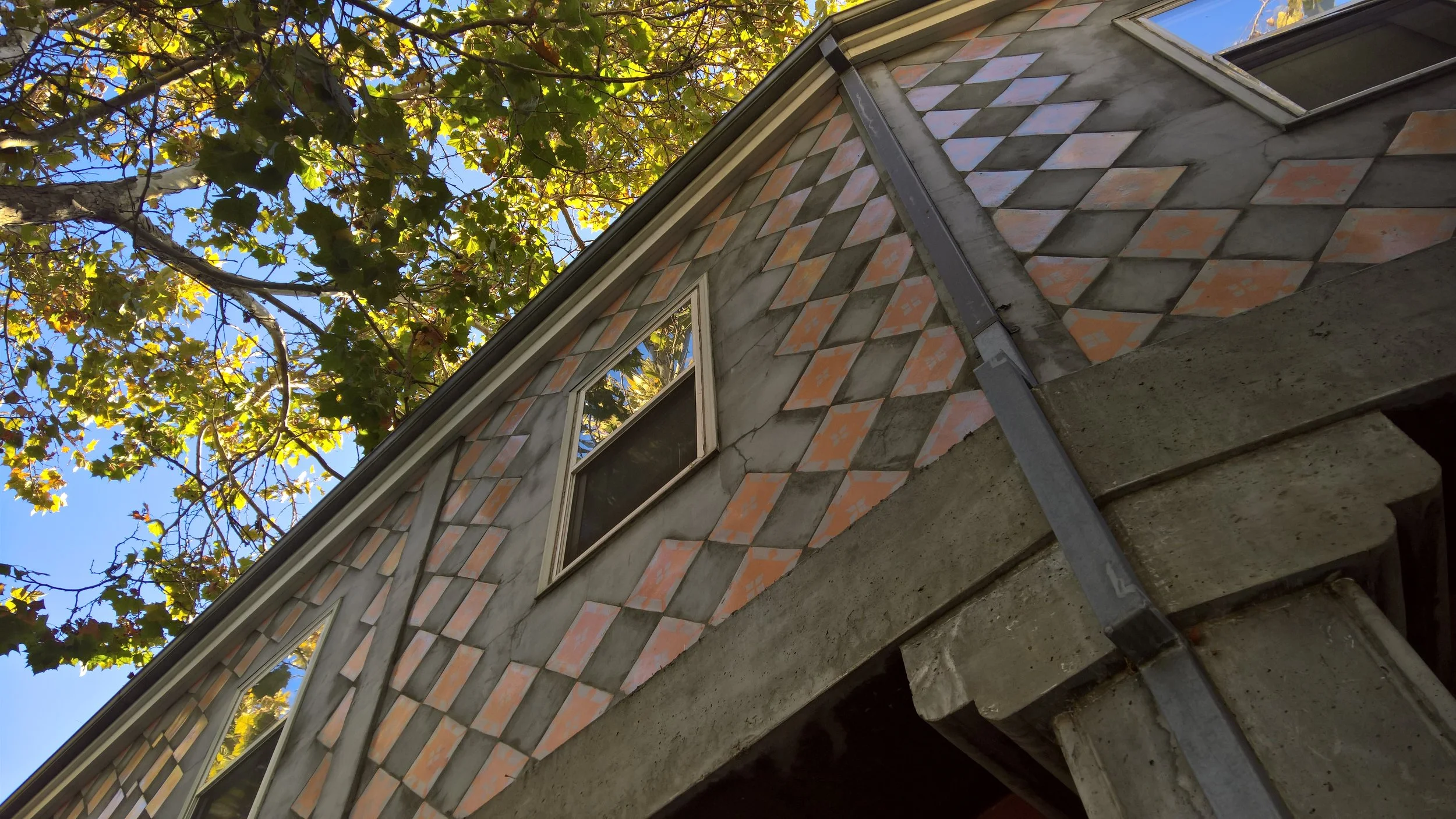
THE JULIAN STREET INN, SHELTER FOR THE HOMELESS, SAN JOSE, CALIFORNIA, (with Gary Black, Eleni Coromvli), Concrete columns, open lacework trusses, hand made column capitals, hand painted tile exterior, tiles fountain with lions head, dormitories with individual sleeping alcoves, tile roofs, gardens and courtyards.
by Christopher Alexander (1990)
Beauty is a light-hearted, easy thing, that sits on cobwebs, a cushion on a chair, a single camellia blossom hanging in the mouth of a jam jar. A man sitting relaxed, hands on his knees. A fence running across a hilly terrain, moving and waving with the up slopes and down slopes. Beauty is this quality, multiplied, simplified, at rest. Beauty is rare, precious.
Real beauty comes from layered and overlapping wholes and living centers. Above all, it comes from the multiplication of these living centers. It is soft, gentle, something that quietly celebrates life, without showing off, supports being more than doing, gives more often than it takes. It is marked by gracefulness of essence, not by gracefulness of its exterior. The multiplication which occurs in beauty, is a multiplication of possibility. It is not a shell which keeps you distant, but something which pulls you in, and makes you free -- encourages and allows you to be yourself, and to be free.
That multiplication, when it occurs, supports other forms of life, supports our lives, and appears, physically, in its gentleness.
We can repair the beauty structure on our Earth, only if we understand it.
The beauty structure is inherent in geometry. But once again, the "geometry" is not what it seems. When people speak about geometry, today, they are referring, most of the time, to very simple structures: rectangles, circles, straight lines, simple curves. These elementary forms, learned by every school boy and girl in elementary mathematics classes. Most of the buildings, roads, and neighborhood layouts of the 20th century era, were based on this sort of geometry.
Beauty structure is not likely to appear in a world of these kinds of forms. The geometry of nature, the geometry of complex adaptive systems, and the geometry which must inevitably be present, in any part of living Earth, is an adaptive structure of wholes and centers, being gently fitted to one another.
Even fractal geometry, sometimes put forward as an antidote to rigid geometry, is not the geometry of living structure. It does slightly resemble living structure, because of the multiplicity of scales that are inherent in it. But a fractal design, is made by following a rule endlessly. Living structure comes about by a process which is adapting constantly; each part is different, not because of the rule that forms it, but because the surroundings of each act, each whole, each center, is different every time. The living structure plays with this variation, and, by adapting to it, makes something perfect, even while in another sense, it is imperfect, and filled with imperfections.
Christopher Alexander, 2008, unpublished
Our Birthright
[W]hen I talk to politicians, to townspeople, to developers, when I watch the reaction in the newspapers, when I observe the studied (and to me frightening) neutrality of the journalist preparing to write his story, the most frightening thing of all is the loss that people have of their own feeling…
Christopher Alexander ends A Vision of a Living World, Book 3 of The Nature of Order series (pp.681-3) with this passage.
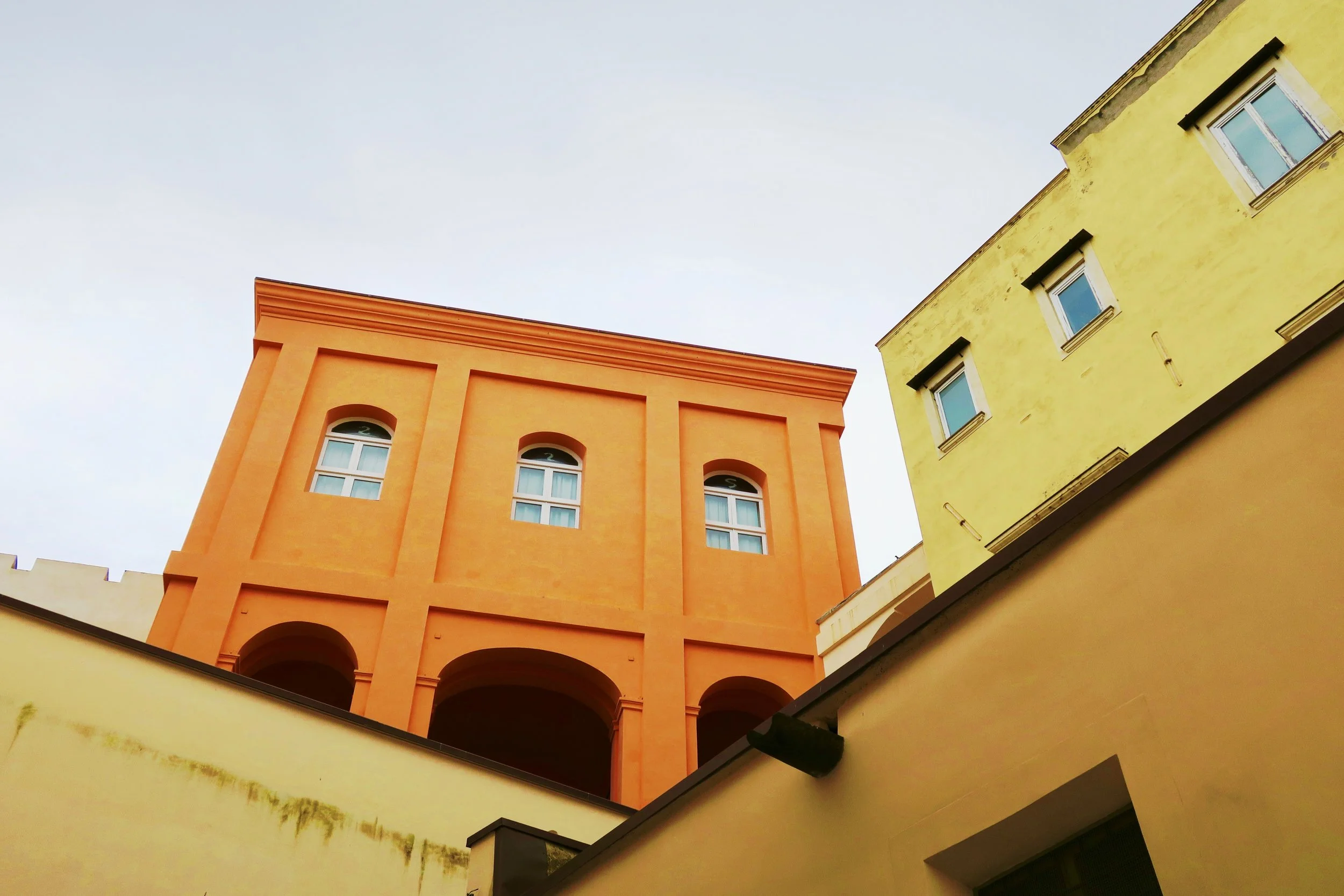
BACK OF THE MOON COMMUNITY, Austin, Texas.
Three private houses on Lake Travis
by Christopher Alexander (1994-5)
I should like to make one last comment on the buildings I have shown, the processes, the forms. Throughout, in all this material, we touch on a birthright. Yet this birthright that I speak of, it is in the mind, in people’s minds. And it is almost gone.
During the years that I have been writing this book, and especially in these last five or six years of intense effort, I walk about the world, I am in touch with people struggling to create, or to protect, their environment. Often people are trying to protect their world, trying to make it comfortable, lovely, but fighting against an enormous wave of indifference, of the juggernaut seeming to bring the crushing load of development, roads, high buildings, profit-oriented buildings into the world, destroying much that is beautiful, bringing people almost to despair.
And in all this that I observe, when I talk to politicians, to townspeople, to developers, when I watch the reaction in the newspapers, when I observe the studied (and to me frightening) neutrality of the journalist preparing to write his story, the most frightening thing of all is the loss that people have of their own feeling.
They no longer know what is inside them, they no longer know what they do know. That is the birthright I refer to, that is the birthright which is being lost.
The birthright being lost is not only the beautiful Earth, the lovely buildings people made in ancient times, the possibility of beauty and living structure all around. The birthright I speak of is something far more terrible; it is the fact that people have become inured to ugliness, that they accept the ravages of developers without even knowing that anything is wrong. In short, it is their own minds they have lost, the core, that core of them, from which judgment can be made, the inner knowledge of what it is to be a person, the knowledge of right and wrong, of beautiful and ugliness, of life and deadness.
And since this inner voice is lost, stilled, muted, there is no possibility — or hardly any possibility — that they can cry out, ‘‘Oh stop this ugliness, stop this deadness which floods like a tide over the land.’’ They cannot do that successfully, too often they cannot even cry out, or let the cry be heard, because the source of such a cry has almost been stilled in them.
That process, it seems to me, is nearly irreversible since, at least to an extent, this knowledge is culture-borne. If there were ever to be a generation of 6billion of us on Earth in which this voice was permanently stilled, the awareness would be gone forever. How could a later generation ever wake to it again, if it is once gone?
Yet we are not far from that state.
I see people, almost lost, like zombies, in the night hours at giant warehouse stores like Toys‘-R’Us. I watch the vacant stare of people playing computer games. I speak with computer programmers who are aware of something, some trouble, but are unable to tell what is troubling them. I have seen, so often, people gather around a table, in a council chamber, preparing themselves for the passage of some latest ravage: a building or a mass development which will destroy. And, often, there are more people who have uneasy feelings of doubt about that development than there are voices of certainty who want to push it through. Yet the voices of doubt are muted, a little quiet, because they do not quite know how to express their fears. They do not quite know if they are right. They do not quite know if they are morally justified in pushing, when the issues are so cloudy. And those who propose, and push through the horrible developments, with monster parking lots, with steel-clad warehouse buildings, with machine-based sales — they go forward blindly, they seem so sure, they seem to know what to do. So, the more timid, perhaps more humane doubters who are not so sure that this is really a good thing, lose the initiative, allow the horrors to go through, to pass — because they are not quite, quite, sure enough of what should be.
Unsure as they are, they vote for it. Sometimes they vote by silence. Sometimes they vote positively, actively, because ‘‘who are they to stand in the way of progress.’’ And all this is caused because the inner certainty, the knowledge of what is living structure has been taken from us, has been diluted, has been rendered nearly ineffective.
That is what I mean by the loss of our birthright.
In Book 1, I showed how the knowledge of living structure is connected to our knowledge of our own self. I showed that the living structure in things may be recognized by the way it seems to reflect our own true self. But this idea is obscure. It seems hardly appropriate — hardly responsible, even — to insist on something so refined when matters of money, food, roads, cars, parking are at stake. How can one be so self-indulgent as to insist, publicly, on something that touches the heart, when the practical matters of time, and money, and development — always the precious money-driven ‘‘development’’ — when these are at stake? So people subdue their voices. They keep quiet. They do not know what to say.
That is what I mean by the loss of birthright.
And there is, too, the enormous difficulty of practical process, of the certainty that this can be done, in practice, on a large scale. I have shown in hundreds of cases throughout this book that these things can be done right, that our society does have the capacity to create living structure, that it can be done, that unfolding, like nature, can be maintained in human society as a natural process.
But, faced with a decision about a huge complex of eight multiplex cinemas on the edge of a beautiful bit of land, threatening the environment yet again, when people need entertainment — who has the stamina to insist that it can be stopped, that it can be done right, that it must be done, we must not go forward until it can be done.
No one wants to look like a fool. If you stand up and insist that this can be done, will you not perhaps look like a fool with your weak tender arguments, while money, time, permissions, and the planning processes are marching on. Perhaps someone will lose money they have invested because of your gentle voice. Is it not then far better, gently, to drop out of the discussion, stay away, allow the developer to make his million dollars without too much protest?
After all, there really is no way to say it that quite clinches it. No way to be sure. No way to assert it positively, so that you can be sure not to look like a fool.
That is what I mean by the loss of birthright.
What has been lost is the inner language which connects you to your own soul, which makes you know, with certainty, which way is likely to be right, and which way is likely to be wrong. To be more clear about it. To feel it, as a real thing. To know, listen to, the voice that is in your own heart.
But that is becoming harder and harder. Even as people are becoming more and more sophisticated, and education is increasing, this inner voice is falling further and further into the background.
That is what I mean by the loss of birthright.
IS THERE SOME CHANCE — NOW THAT THESE MATTERS HAVE BEEN BROUGHT INTO THE OPEN AND THAT LIVING PROCESS HAS BEEN PARTIALLY DEFINED — THAT THIS BIRTHRIGHT MAY BE SAVED, AND THAT WE CAN COME BACK TO WHAT IS OURS AGAIN ?
The Geometry of Living Neighborhoods
For the greater part, these things are all made by fitting – by gradual and careful adjustment – to the land, one room to another, a doorway to a beam, a vaulted ceiling to an odd-shaped room. In short they are generated forms…
by Christopher Alexander
Now, what do I mean by geometry? When we use the word geometry, we most immediately think of Euclid, of straight lines, rectangles, circles. This is a very narrow branch of geometry that deals with the mathematics of a few idealized shapes, which can be used, on occasion, to deal with human matters.
The world, the world of nature, the world of forests, of agriculture, the world of villages, the world of buildings – these things of this world, do not have the idealized shapes, and Euclid’s geometry comes nowhere near being able to describe them. Real things come about in part by accidental collision with other things – things that are adapted to the slopes of hills, fences that run across a piece of rolling country, houses that have roofs adapted to the light and to the sun, wind shelters, dovecotes, sheep pens, windows that are friendly to the light, the shapes of a piano or a Celtic harp, suits made for people, the arms of a favorite armchair, the full line of a woman’s cloak, the curves of a Porsche 365, or a Harley Davidson.
These are things we live with. They have geometry, but they have a more complex kind of shape, they have relationships with other shapes, and more harmonious lines and curves that make our world.
For the greater part, these things are all made by fitting – by gradual and careful adjustment – to the land, one room to another, a doorway to a beam, a vaulted ceiling to an odd-shaped room. In short they are generated forms. They cannot be described adequately by equations or by drawing straight lines. Most of them are far too complex for that. The same is true, of course, for the objects created by nature – rock, cliffs, sand dunes, trees and tree trunks, human bodies, animal shapes, the shape of a cat’s eye. It is the same with these things, as it is with things that human beings have built. So the language of these shapes must be a language of generative process, because it is only in the steps taken to achieve the shape, that we can record and capture the shapes and forms even to reproduce them.
Christopher Alexander