
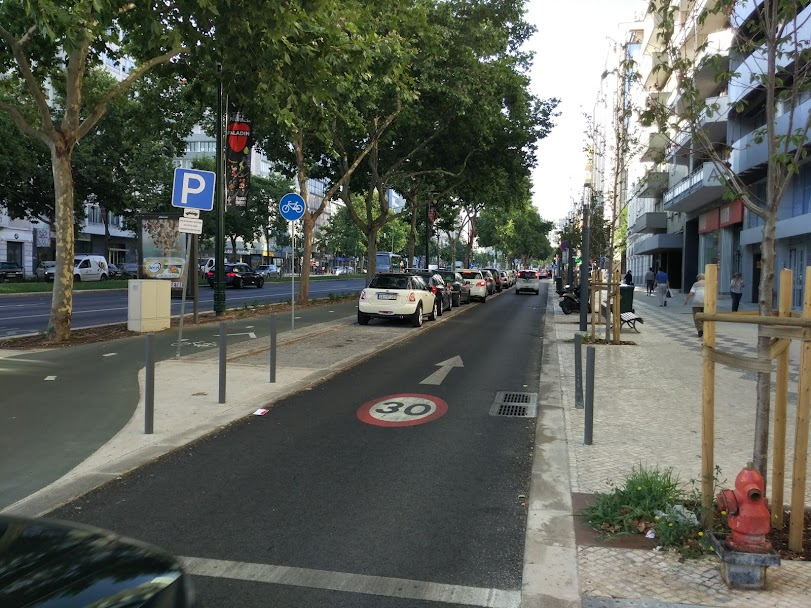
Avenida da Republica, Lisbon an example of the change brought about by the new paradigm, photo credit: Y. Rofe'
In Book 2 of The Nature of Order Alexander discusses the need to change the paradigm of development, to allow the recreation of a living world. The magnitude of the task seems almost beyond human capacity. Yet, in the past 60 years, since the beginning of the 1960's there has been a gradual change in the paradigm governing urban planning. From a paradigm trying to adapt cities to cars and concerned mostly with the ease and speed of mobility to a paradigm that looks at human accessibility to desired destinations - at a lower social, economic and environmental cost while maximizing the benefits of dense urban environments. This shows that profound paradigm changes are possible, and actually happen when there's a widespread realization of the failure of an existing paradigm to resolve inherent conflicts.
Alexander's work has been influential as part of the movement to change the paradigm of urban planning, from spatial planning to a place making paradigm. He's considered as one of the foundational thinkers of both the Congress for New Urbanism and the Project for Public Spaces organizations. Some of the patterns included in A Pattern Language also helped to create a change in the practice of urban planning. Many of the ingredients of the new paradigm are also included in the new Pattern Language for Growing Regions authored by Michael Mehaffy and colleagues. The lecture will point out these contributions, while showing the patterns that form the basis of the new paradigm.
Yodan Rofe' is an architect and urban designer. He taught urban planning and design at Ben-Gurion University of the Negev in Israel, and is the Course Director of Building Beauty.
The webinar will take place on Thursday, November 19 at 16:00 UTC.